Pasado en inglés: cuándo usar cada tiempo verbal
Enviado por Comunidad Xuletas y clasificado en Inglés
Escrito el en  español con un tamaño de 5,69 KB
Tiempos del pasado en inglés
Be: was/were, been (ser / estar)
¡Buenos días! En esta entrada repasaremos todos los tiempos verbales que se utilizan para expresar el pasado. Trataremos las siguientes formas verbales:
- Past Simple
- Past Continuous
- Present Perfect
- Past Perfect
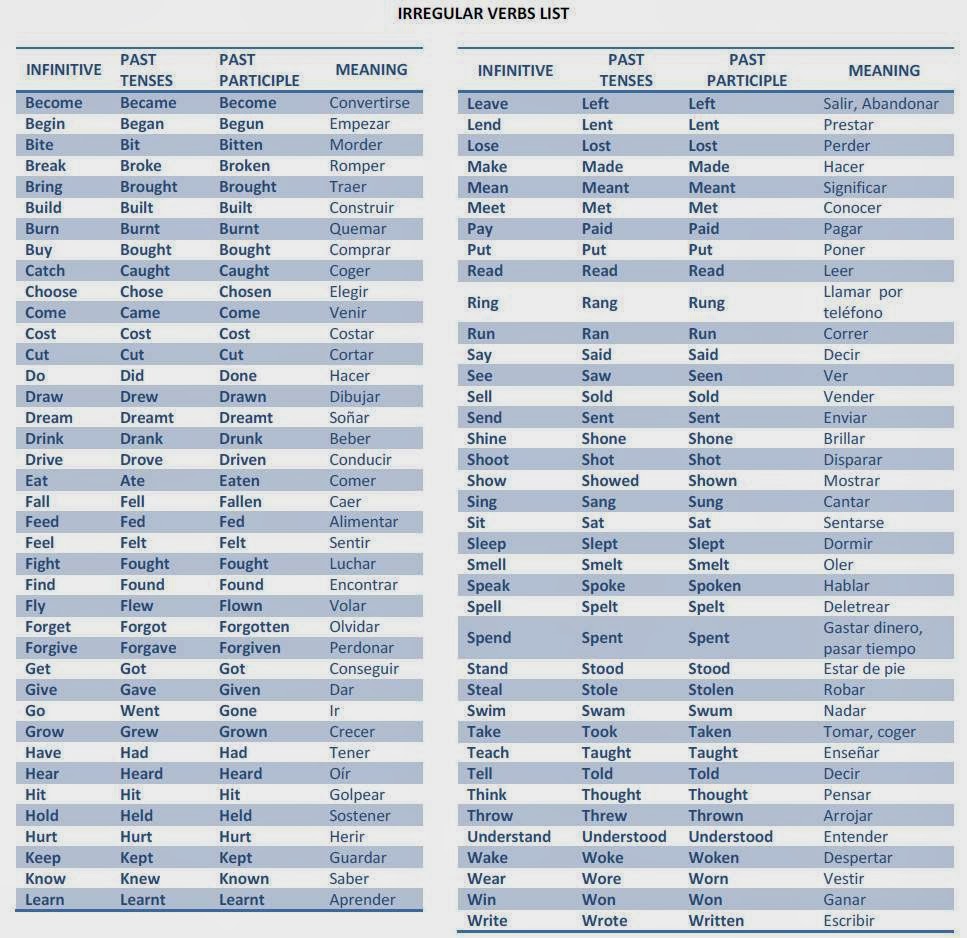
Os dejo un vídeo de Selvaingles en el que nos enseñan a utilizar los tiempos verbales correspondientes (Past Simple, Present Perfect o Past Perfect), principalmente los irregulares, utilizando siempre un adverbio o expresión de tiempo en una oración. De esta manera se quedará más fijado que si nos limitamos a aprendernos de memoria la lista de verbos irregulares con las tres columnas (infinitive, past simple, past participle).
Past Simple
- Afirmative: They got married last year.
- Negative: I didn't have time to do my homework.
- Interrogative: What time did you wake up this morning?
Uses
- Use the Past Simple for a completed action in the past:
- Sophie finished school in 2010.
- A series of completed actions in the past:
- When she worked as a journalist, he met interesting people and travelled to faraway countries.
Time expressions
yesterday, last week, two days ago, in 2011, in the 1960s, in the 19th century, when, then.
Past Continuous
- Afirmative: The driver lost control of his car because he was talking on his mobile.
- Negative: I was not (wasn't) dancing.
- Interrogative: What were you doing at six o'clock last night?
I was dancing
You were dancing
He / She / It was dancing
We / You / They were dancing
Uses
- An incomplete action in progress at a specific time in the past:
- Last year she was working as a waitress.
- An incomplete action interrupted by another action:
- Tom was cooking dinner when someone knocked at the door.
- Two incomplete actions taking place at the same time in the past:
- They were listening to music while they were sunbathing.
Time expressions
at two o'clock, last month, last year, when, while, as.
Present Perfect
- Afirmative: She has never met (she's met) his ex-wife.
- Negative: I've been to London, but I haven't been to Cambridge.
- Interrogative: Have you ever lost your credit card?
Uses
- An action that took place at an unstated time in the past, but is connected to the present:
- I'm not going to the cinema with them tonight because I've already seen that film.
- Broadway musicals have always been famous.
- An action that started in the past and continues to the present:
- The singer hasn't performed for over a month.
- She has had a TV show since 1995.
- How long has the band toured around the world?
Time expressions
always, so far, ever, never, just, yet, recently, already, in recent years, for, since, how long?
Past Perfect
- Afirmative: When they turned on the TV, the match had already finished.
- Negative: We couldn't get a table in the restaurant because we hadn't booked.
- Interrogative: Had you eaten?
Uses
- An action which happened before another action in the past:
- I had never been to a live concert until I went to the Shakira concert.
- The actor had grown a beard before appearing in that film.
- I felt nervous because I hadn't flown before.
Time expressions
already, by the time, after, before, until, never, just.
Verbos regulares e irregulares
Cuando el verbo es regular, para formar el pasado y el participio basta con agregar -ed al final del verbo.
En el caso de los verbos irregulares, tendremos que aprenderlos de memoria. Aquí hay una lista de los más comunes: